


Tanzania is endowed with various climatic conditions, topography and wide range of altitude favoring the presence of different natural vegetation that includes forests, bushes herbs, and weeds.
In many regions of the country, beekeeping is considered as one of the alternative income generating activities for resource poor farmers including women, youth and unemployed sectors of the community. Beekeeping also provides attractive options for rural employment and income generation in harsh agro-ecosystem where crop production is marginal and the risk of crop failure is high. With a production of 34 metric tons, Tanzania is Africa’s second largest honey producer.
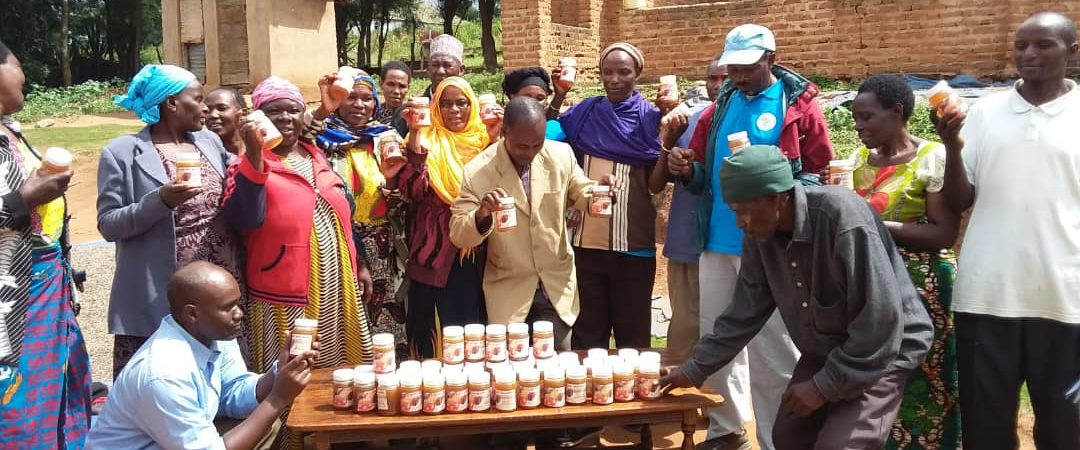
In Hanang and Mbulu Districts in Manyara region smallholder farmer’s members of MVIWATA have started considering beekeeping as a source of income generation and nutritional food. This has been revealed through the production of natural organic honey. With a number of technical trainings facilitated by MVIWATA under the support of TRIAS, the smallholder farmers in Mbulu and Hanang Districts are now reaping the fruits of beekeeping.
The trained smallholder farmers’ groups are now using the value chain addition knowledge to process their honey, package and label them, ready for sale. The income obtained from selling honey is wisely used by the group by re-investing on the beekeeping as there is a big market for organic honey locally and at global levels. Smallholder farmers in Manyara region and Tanzania at large have a number of opportunities in beekeeping which includes availability of natural forest with adequate beekeeping flora and water, Existence of strong bee and a number of colonies, Market access, Diversity and seasonal availability of bee forages.
MVIWATA through a coordination office (middle level network) in Manyara region has started to tirelessly use the opportunities in supporting MVIWATA members and smallholder farmers at large mostly youth and women to benefit in beekeeping.
There are number of challenges that surrounds smallholder farmers from benefiting well in beekeeping. These includes Lack of organized marketing system and information asymmetry, Lack of improved honey beekeeping and product processing equipment, Lack of skill and knowledge of bee keeping to most of smallholder farmers, Lack of cooperatively established market system and institutional linkage in most places where MVIWATA has not reached and Honey bee enemies and agricultural chemicals.
MVIWATA is using all means possible to harness the opportunities available in supporting smallholder farmers in apiculture. Among the strategies to combat the challenges in apiculture are training of farmers on agro-ecology practices, organize smallholder farmers in groups and finally cooperatives for easy management of their produce and symmetry of market information